Fluorescein
 Let's break it down: Fluorescein is a fluorescent tracer that can be used in a variety of ways, from microscopy of biological organisms to understanding the flow of rivers. NASA also used this to find space capsules that landed in the ocean. This non-toxic bright green color can be created in a glass bowl of water after the fluorescein has been harvested from ordinary highlighters.
Oobleck
 Let's break it down: Fluids and solids typically behave very differently from one another, but that's not so with oobleck. A simple 2:1 ratio of starch and water, oobleck is known as a non-Newtonian fluid. While it has the regular, free-flowing attributes or an ordinary fluid most of the time, it firms up and acts like a solid when force is applied.
Dancing Oobleck
 Let's break it down: Sure, sometimes applying force to oobleck in the form of punching or walking on it is pretty fun, but it's also pretty mesmerizing to let sound waves control this slimy substance. In order to make this ooze dance, put oobleck on top of a speaker, and crank up the bass. The sound waves will push the oobleck into forming solid shapes as they dance around. If this isn't hypnotizing enough for you, add in some food dye and watch the colors swirl together.
Freezing Water Instantly
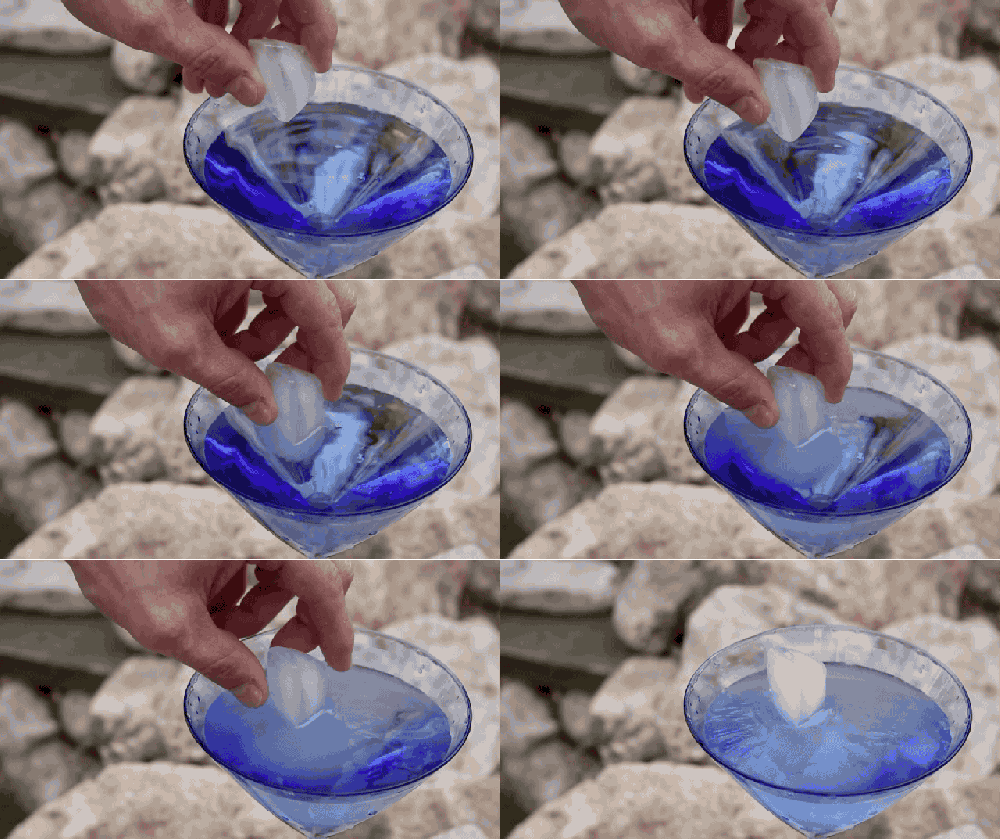 Let's break it down: If you've been dying to control ice just like Elsa, now's your chance. Purified water is able to be cooled past freezing temperatures while staying as a liquid, as long as there isn't a nucleus for the ice crystal to form, like an impurity in the water or another piece of ice, as shown. The water is so cold, that the introduction of an ice crystal causes a runaway freezing effect throughout all of the supercooled water.
Melting Spoon
 Let's break it down: No, this spoon isn't stirring a nice hot cup of acid or anything like that. The utensil is actually made out of gallium, which is a metal with a melting point of only 85 degrees Fahrenheit. By merely stirring a mug of water barely warm enough to steep tea, the metal actually melts and breaks apart easily.
You can also melt gallium just by holding it in your hand, as your body temperature is enough to reduce the metal to a puddle. It's kind of like what your parents did with mercury, but a whole lot less toxic.
Magnetic Liquid
 Let's break it down: The reason this black liquid can be manipulated through the glass is because it is a magnetic substance known as a ferrofluid. You can actually make a batch of this yourself, simply using ink toner, vegetable oil, and a rare Earth magnet that can be found at your local hardware store.
WARNING: Your productivity is sure to decrease with a jar of this on your desk.
Instant Hot Ice
 Let's break it down: Just how the supercooled water had a runaway freezing effect when it came in contact with ice, sodium acetate (the stuff in reusable hand warmers) does the same thing. When the solution is disturbed enough to have a point of nucleation, the supersaturated formula quickly creates crystals and lets off heat. Pouring the solution out onto a plate will form "hot ice" sculptures.
Disappearing Marbles
 Let's break it down: The spoon clearly pulls clear marbles out of the water, but the instant they're submersed, they seem to disappear. The marbles are made out of a super-absorbent polysaccharide which can hold over 300 times its weight in water.
When they're completely full of water, they have a refraction index very similar to water itself, meaning that light bends in the same way through water as it does through the marble. Without light bending in a way that differentiates the marble to our eyes, they're essentially invisible.
Colorful Milk Art
 Let's break it down: The surface tension on the milk is reduced when it's touched by the cotton swab, which has been dipped in regular dish soap. The parts of the milk that haven't been affected by the soap try to run away, which ends up mixing the color in with the milk. Holding the swab in place for a while or putting in a couple of them in different places will cause even more crazy swirl patterns.
Dry Ice Bubble
 Let's break it down: No, this isn't a mini nuclear explosion, this is what happens when the fun of bubbles intersects with the creepy-yet-cool nature of dry ice. Dry ice, which can be bought at nearly any grocery store, is frozen carbon dioxide. When a chunk of this ice is put into water, it produces a great deal of steam. By adding some dish soap to the water before adding the dry ice, you can make a bubble that takes up the entire area of the bowl. When the bubble pops, it has a hauntingly beautiful appearance as the steam is freed.
Waterproof Sand
 Let's break it down: The sand being poured into the beaker has been coated with a hydrophobic chemical, which means that the sand does not like water. It won't dissolve, and the grains will clump together as best as they can to avoid contacting the water. This allows for the creation of snake-like underwater sculptures. When the sand is spooned back out of the water, it acts like ordinary sand once again, losing its shape.
Flammable Gummy Bears
 Let's break it down: It's a total myth that eating sugar causes someone to have an excessive amount of energy. (Yep. The "sugar buzz" is completely made up.) However, you can get an incredibly energetic reaction from candy (well, the carbohydrates in the candy) by dropping it in a little heated potassium chlorate. The resulting reaction is extremely exothermic, meaning it releases heat.
Luckily, that's not at all what happens when a gummy bear (and 30 of his friends) get eaten by human beings.
Water Bending
 Let's break it down: When a stream of water is flowing out of the bottle, the scientist is able to bend it just by holding a pipe near it. Is the water completely contaminated? Is this cause for concern?
Nah, it's just static electricity. The positively charged particles in the water are attracted to the negatively charged particle on the pipe. When they're brought close enough to one another, the water will actually bend toward the pipe. You can do the same thing by running a plastic comb through your hair a few times and holding it near water running out of a faucet.
Slowing Down Gravity
 Let's break it down: No, the person in the video doesn't have lightning-fast reflexes that allow for the cube to be caught by the time it passes through the copper tube. The cube that is being spun into the tube is actually a magnet. The magnet actually isn't attracted to the copper pipe itself, but the magnetic field created by the pipe interacts with the one from the magnet itself, slowing the fall. The force of gravity is ultimately stronger than the force slowing it down, and the magnet does eventually fall out, albeit at a much slower pace than you'd expect.
Oobleck

Dancing Oobleck
Freezing Water Instantly
Melting Spoon
You can also melt gallium just by holding it in your hand, as your body temperature is enough to reduce the metal to a puddle. It's kind of like what your parents did with mercury, but a whole lot less toxic.
Magnetic Liquid
WARNING: Your productivity is sure to decrease with a jar of this on your desk.
Instant Hot Ice
Disappearing Marbles
When they're completely full of water, they have a refraction index very similar to water itself, meaning that light bends in the same way through water as it does through the marble. Without light bending in a way that differentiates the marble to our eyes, they're essentially invisible.
Colorful Milk Art
Dry Ice Bubble
Waterproof Sand
Flammable Gummy Bears
Luckily, that's not at all what happens when a gummy bear (and 30 of his friends) get eaten by human beings.
Water Bending
Nah, it's just static electricity. The positively charged particles in the water are attracted to the negatively charged particle on the pipe. When they're brought close enough to one another, the water will actually bend toward the pipe. You can do the same thing by running a plastic comb through your hair a few times and holding it near water running out of a faucet.
Slowing Down Gravity


